

Investors exploring 1031 exchange alternatives are increasingly turning to passive real estate investments such as Delaware Statutory Trusts (DSTs) and Installment Sale Trusts (ISTs) to reduce management responsibilities while preserving long-term tax deferral opportunities. Understanding how these strategies differ can help investors align their real estate decisions with both financial and lifestyle goals.
For decades, the traditional 1031 exchange has been one of the most widely used strategies for deferring capital gains taxes when selling investment real estate. But today’s investors are increasingly exploring alternative structures that offer greater flexibility, reduced management responsibilities, and different approaches to preserving and deploying capital.
The reality is that not every investor wants to sell one actively managed property only to acquire another.
For some, the goal is to simplify. For others, it’s diversification, reduced operational involvement, or preserving lifestyle flexibility while keeping capital working efficiently.
Understanding the differences between these strategies is critical before making a decision.

What Is a Traditional 1031 Exchange?
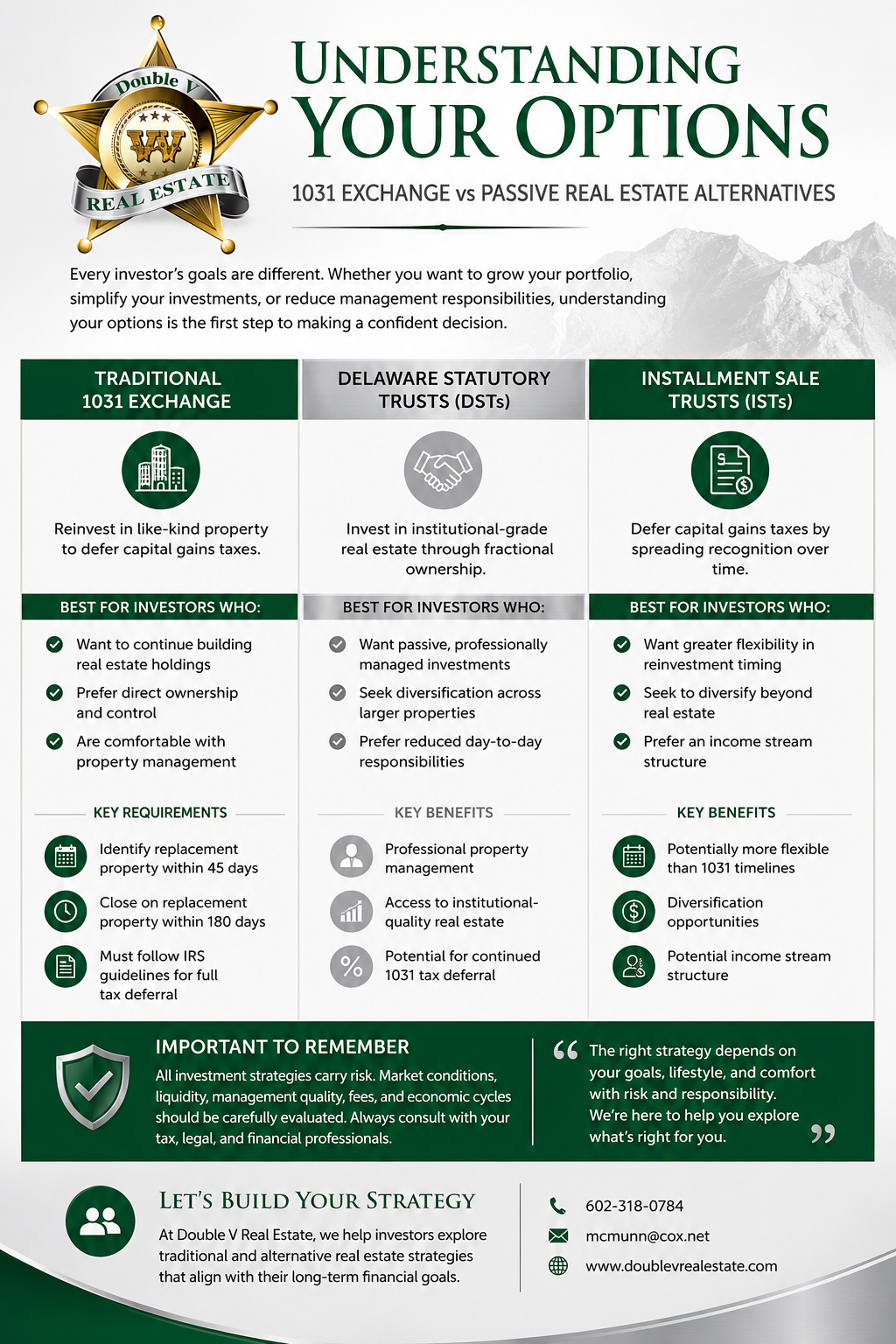
A traditional 1031 exchange allows investors to defer capital gains taxes by reinvesting proceeds from the sale of one investment property into another qualifying “like-kind” property.
This strategy can be highly effective for investors who want to:
* Continue building real estate holdings
* Upgrade into larger or more profitable assets
* Consolidate or diversify property portfolios
* Preserve capital that would otherwise go toward taxes
However, 1031 exchanges come with strict timelines and requirements.
Investors must typically:
* Identify replacement properties within 45 days
* Close within 180 days
* Reinvest proceeds according to IRS guidelines
For active investors comfortable with ongoing ownership and management, this can be a powerful long-term wealth-building tool.
When Investors Begin Looking for Alternatives
Not every investor wants another active property.
Some owners reach a point where they are:
* Tired of property management responsibilities
* Seeking more passive income structures
* Looking to diversify beyond direct ownership
* Concerned about tight 1031 exchange timelines
* Interested in preserving lifestyle flexibility during retirement or transition periods
This is where alternative structures often enter the conversation.
Understanding Delaware Statutory Trusts (DSTs)
A Delaware Statutory Trust, commonly referred to as a DST, allows investors to place exchange proceeds into fractional ownership interests within institutional-grade real estate assets.
These may include:
* Apartment communities
* Industrial properties
* Medical facilities
* Hospitality assets
* Mixed-use developments
DSTs are often attractive to investors seeking:
* Passive ownership
* Professional asset management
* Diversification across larger properties
* Continued tax deferral through 1031 eligibility
However, DSTs also involve tradeoffs, including reduced control over property decisions and long-term liquidity considerations.
What About Installment Sale Trusts (ISTs)?
Some investors explore installment-based deferral structures, often referred to as Installment Sale Trusts or similar planning strategies.
Unlike a traditional 1031 exchange, these structures may allow sellers to spread recognition of capital gains over time rather than immediately upon sale.
Potential benefits may include:
* Greater flexibility in reinvestment timing
* Diversification opportunities
* Potential income stream structuring
* Reduced pressure from strict exchange deadlines
These strategies are more complex and should always be evaluated with qualified legal, tax, and financial professionals.
Passive Doesn’t Mean Risk-Free
One of the biggest misconceptions investors make is assuming passive structures eliminate risk.
Every investment carries considerations including:
* Market performance
* Liquidity
* Sponsor or management quality
* Fee structures
* Economic cycles
* Regulatory and tax implications
The goal is not to eliminate risk entirely, but to align investment structure with personal goals, lifestyle preferences, and risk tolerance.
The Right Strategy Depends on the Investor
There is no universally “best” option.
For some investors, direct ownership through a traditional 1031 exchange remains the ideal path.
For others, passive structures may provide a more suitable balance between income potential, flexibility, and lifestyle considerations.
The key is understanding the full range of available options before making a major decision.
At Double V Real Estate, we work with investors exploring both traditional and alternative real estate investment strategies, including condo-hotel ownership, passive real estate structures, and income-producing opportunities designed to align with long-term portfolio goals.
If you are evaluating a sale, considering a 1031 exchange, or simply exploring what options may fit your situation, we are happy to help guide the conversation and connect you with appropriate resources and professionals when needed.
To learn more about current opportunities or investment structures, contact Double V Real Estate.